

Dubai – Artificial Intelligence Journalism for Research and Forecasting (AIJRF)
The Artificial Intelligence Journalism for Research and Forecasting (AIJRF) has announced the launch of its new Professional Microcredential Certificates Program for university students, as part of its ongoing efforts to strengthen students’ applied skills, integrate Artificial Intelligence and Agentic AI into diverse academic pathways, and better align university learning outcomes with future skills and evolving labor-market requirements.
The new phase of the program covers six major academic and professional sectors: Media, Mass Communication & Artificial Intelligence; Business & Artificial Intelligence; Humanities and Social Sciences & AI Integration; Health and Medical Sciences & Artificial Intelligence; Engineering & Artificial Intelligence; and Cybersecurity, Information Protection & AI Integration.
The initiative is built around a short, intensive, and highly practical training model that enables students to earn a specialized professional microcredential while focusing on hands-on application, project development, advanced AI tools, and the design of AI-powered models and agents that can be applied in real workplace environments. Each certificate is designed to connect directly with the learning outcomes of the relevant academic discipline.
The Microcredential Certificates are also intended to help universities and colleges introduce flexible, skills-focused learning units into academic programs, allowing students to acquire targeted competencies without committing to long-duration programs. Each certificate can be customized according to the discipline, student level, institutional needs, and targeted learning outcomes.

Microcredential Certificate Program in Media, Mass Communication & Agentic AI
- Media, Mass Communication & Agentic AI
This sector is designed to prepare students in media, mass communication, public relations, and digital media for professional environments that increasingly depend on Artificial Intelligence and Agentic AI. Students learn how AI can be applied in smart newsrooms, digital platform management, multimedia content creation, digital public relations, government communication, digital reputation management, audience analytics, fact-checking, data journalism, immersive media, and digital campaign management. They also gain practical experience in designing AI agents capable of supporting selected communication and media-production processes under human supervision.
- Business & Artificial Intelligence
This sector provides students with applied skills for using AI in business, management, and entrepreneurship. Key areas include market analysis, customer relationship management, intelligent marketing, automation, data analytics, decision support, forecasting, project management, innovation, and AI-powered customer service. Students also learn how to design AI Agents for administrative, marketing, analytical, and operational tasks, while using AI technologies to improve productivity, efficiency, and innovative business-model development.
- Humanities and Social Sciences & AI Integration
This pathway enables humanities and social sciences students to use AI as a research, analytical, and knowledge-support tool for understanding social and human phenomena. Students receive practical training in text and document analysis, comparative studies, public-opinion analysis, database development, social and cultural trend analysis, the use of language models in qualitative research, and the management and analysis of academic sources, with particular attention to responsible and ethical AI use.
- Health and Medical Sciences & Artificial Intelligence
This sector focuses on the educational and professional use of AI in health and medical fields. Students are introduced to practical applications in health-data analysis, medical research support, scientific literature review, medical information management, health-awareness content development, data-informed decision support, and health-trend analysis. The program also highlights privacy, data protection, governance, and ethical considerations when using AI systems in healthcare and medical environments.
- Engineering & Artificial Intelligence
This sector introduces students to practical AI integration across engineering disciplines, including intelligent design, engineering-data analysis, simulation, predictive maintenance, project management, modeling, automation, risk analysis, and the use of AI agents to support technical and engineering operations. The pathway aims to strengthen students’ ability to use AI in problem-solving, operational efficiency, and interdisciplinary innovation.
- Cybersecurity, Information Protection & AI Integration
This sector trains students to apply AI in threat monitoring, abnormal-pattern and behavioral analysis, data protection, risk assessment, incident-response support, log analysis, vulnerability management, and cybersecurity awareness. Students also explore how AI Agents can automate selected monitoring, analytical, and reporting functions while maintaining strong ethical, privacy, and security controls.
Media and Mass Communication Track: An Integrated Applied Pathway for the Future of Media
Within the first sector, AIJRF offers a specialized pathway under the umbrella of:
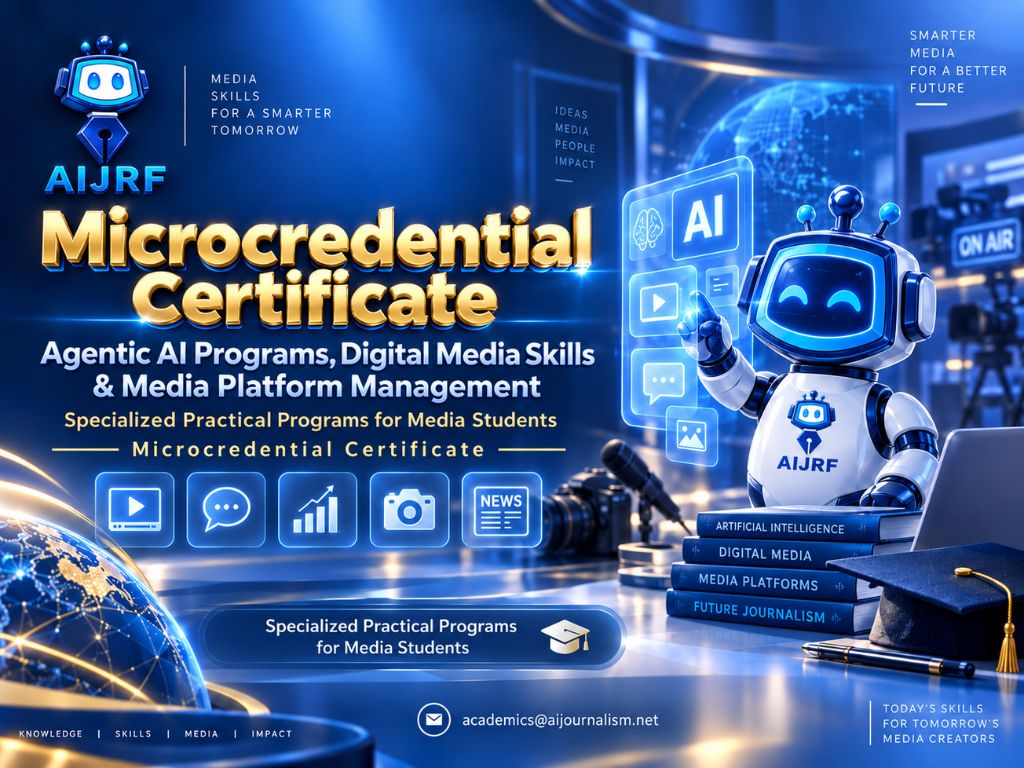
Microcredential Certificates
Agentic AI, Digital Media Skills & Media Platform Management Programs
The program targets students in Media, Mass Communication, Public Relations, Digital Media, Media Design, Journalism Writing and Editing, Government Communication, Content Creation, and Media Organization and Platform Management.
The program follows an applied learning methodology based on 80% hands-on training and 20% conceptual and knowledge-based learning, with extensive use of AI tools and applications tailored to each specialization, together with a final applied project for every microcredential.
Key Specialized Microcredentials in Media and Communication
- Agentic AI for Digital Media & Smart Newsrooms
Students learn how to build an intelligent media workflow starting with trend and topic discovery, moving through information gathering and source analysis, and ending with content production, repurposing, and multi-platform publishing. Participants also develop a Smart Newsroom Agent capable of managing interconnected stages of the media-production process. - AI Agents for Social Media Management & Content Automation
Students receive practical training in audience analysis, persona development, content-calendar creation, text, image and video production, content scheduling, performance analysis, engagement management, and the development of an intelligent agent for social-media account management. - Agentic AI for Public Relations & Digital Reputation
The program focuses on press-release development, media pitching, Q&A preparation, media monitoring, sentiment analysis, reputation tracking, intelligent reporting, and the design of an AI Agent specialized in public relations and digital reputation management. - Agentic AI for Government Communication & Public Engagement
Students learn how to transform public services and policies into accessible audience-focused content, develop FAQ Agents, analyze public inquiries, build awareness campaigns, generate multilingual content, and measure government-communication effectiveness. - Agentic AI for Multimedia Storytelling & Content Creation
This certificate focuses on idea development, scriptwriting, storyboarding, image and video generation, voice-over production, digital characters, content repurposing, and the development of a complete AI-powered workflow for multimedia storytelling. - AI Agents for Fact-Checking, Media Monitoring & Crisis Communication
Students are trained in claim and source verification, news analysis, keyword monitoring, misinformation detection, sentiment analysis, crisis-alert development, and intelligent communication-response planning. - Agentic AI for Digital Campaigns, Audience Analytics & Strategic Communication
Students learn audience analysis, campaign design, message development, content personalization, A/B testing, performance-dashboard development, and the use of AI Agents to continuously optimize communication campaigns. - Agentic AI for Scientific Research & International Publishing
Students receive hands-on training in defining research problems, reviewing literature, identifying research gaps, organizing references, analyzing academic studies, developing research proposals, and using AI Research Agents to support different stages of scientific research. - Agentic AI for Data Journalism, Visualization & Audience Insights
This certificate focuses on collecting, cleaning, and analyzing data, identifying patterns, generating journalistic angles, developing charts and infographics, building dashboards, and transforming datasets into interactive media stories. - Agentic AI for Immersive Media, 3D Content & Virtual Presenters
Students explore immersive-experience design, 3D content production, virtual characters and presenters, AI-powered audio and video production, and the development of interactive media experiences using advanced AI technologies. - Agentic AI for Media Design, 3D Graphics & Animation
This certificate focuses on using Artificial Intelligence and Agentic AI to advance media design and modern visual production, including visual identity design, digital graphics, infographics, 3D elements and scenes, animation, motion content, and AI-supported creative workflows.
Students are trained to transform ideas and written concepts into visual assets, create professional media graphics, design 3D Objects and 3D Scenes, develop digital characters, produce Motion Graphics and Animation, turn static visuals into animated content, and create integrated visual materials for social media, websites, and digital campaigns. They also learn how to build an AI Design Workflow connecting ideation, design, 3D production, animation, editing, and final multi-platform output.
The final project is an AI-Powered Media Design Portfolio Project featuring an integrated set of media designs, a 3D element or scene, and a short animation, all developed within a unified visual identity suitable for a media project or digital campaign.
Two Days and Seven Hours of Applied Training Per Certificate
Each Microcredential Certificate is delivered through an intensive model typically spanning two days and seven hours of practical training, including hands-on exercises, applied tasks, and a final practical project that demonstrates the student’s ability to transform newly acquired knowledge into a product, model, or workflow with real-world application potential.
AIJRF’s approach is designed to ensure that every participant completes the program with a clearly defined skill, a practical project, and a genuine hands-on learning experience that can be added to their Professional Portfolio, strengthening their readiness for internships, employment, and future digital workplaces increasingly shaped by Artificial Intelligence.
More Than 100 Programs Customizable to University Needs
AIJRF’s training portfolio currently includes more than 100 specialized programs integrating Artificial Intelligence and Agentic AI across multiple academic and professional disciplines. The Foundation can also design customized Microcredential Certificates and training programs based on the specific needs of universities, colleges, academic departments, students, and faculty members.
AIJRF develops its programs according to the principle of “From Academic Need to Practical Application,” covering the identification of target skills, selection of appropriate AI tools, design of applied activities, development of final projects, and alignment of learning outcomes with labor-market requirements.
About AIJRF :
Artificial Intelligence Journalism for Research and Forecasting (AIJRF) is the first leading academic and applied institution and think tank in media studies, artificial intelligence and content in general, the Media of the Metaverse , and technologies of the Fourth and Fifth Industrial Revolutions. It was founded in 2018 in the United Arab Emirates, by a group of professors and researchers specialized in media studies, artificial intelligence, the fourth industrial revolution, and the humanities.
AIJRF currently has more than 25 global and regional initiatives in artificial intelligence, media, and university education, and has more than 120 training programs, including “professional diplomas” and specialized programs in using artificial intelligence tools and applications and integrating them into a number of specializations, including : “Education, Media, Intelligent Government Services, Financial Services, Marketing, the Metaverse, Future Cities, Sustainable Development, and creating all forms of content using artificial intelligence.”
AIJRF Works on Three Main Pillars:
1- AIJRF provides Academic and scientific research, reports and educational curricula in Artificial Intelligence Journalism, Media of Metaverse, 7G Journalism, Robotization of Marketing and AI & Media.
2- AIJRF works to develop new tools, technologies, Apps and solutions in the content industry through artificial intelligence and Metaverse in the fields of: media, education, healthcare, and the Intelligence Government Services.
3- AIJRF Develops and upgrades the Dynamic Human Skills (DHS) of individuals, institutions, universities and governments in line with the requirements of the Fourth and Fifth Industrial Revolutions and the skills of the future and Media of Metaverse.