


Abass Azanjani, AI Researcher
Just a few years ago, artificial intelligence seemed to most people like a more advanced version of a search engine such as Google. But instead of simply displaying links and websites that might contain an answer, users could get a direct response, ask AI to write text or generate an image or video, among many other tasks.
That picture has changed quickly. AI is no longer simply a tool that answers questions or generates content. The conversation is no longer limited to what AI can tell us, but increasingly to what it can do.
Some systems can use tools, write code, carry out sequences of tasks and interact with other computer systems. Inside AI laboratories, models themselves are helping researchers with programming, testing and the development of new technologies.
With each new leap, the pace of change has become increasingly difficult for ordinary people, and even specialists, to follow.
The question is no longer simply how much smarter AI will become. It has expanded to what could happen as AI begins to play a greater role in developing the next generation of AI systems.
New Concepts in AI
This acceleration has brought terms once largely confined to technical circles into the public conversation. Technological singularity, AI agents, sandboxes, artificial general intelligence and narrow AI are increasingly part of the discussion. The names Hugging Face and Anthropic have also appeared in reports about security incidents involving cybersecurity evaluations of AI systems.
Behind each of these terms is a different part of the transformation taking place across the industry.

A conceptual view of technological singularity and the uncertainty surrounding increasingly capable AI. Concept and creative direction by Abass Azanjani
Singularity
Technological singularity is not a new technology, nor is it a stage the world has been shown to have reached. The term refers to a hypothesis in which technological development accelerates to a point where predicting what comes next becomes extremely difficult.
One version of that hypothesis involves AI systems playing an increasingly significant role in developing systems more capable than themselves.
That does not mean machines today are independently building their own successors. But AI systems are already being used to write code, test software, analyze technical problems and assist researchers in development. That leaves an open question about what could happen if their contribution to developing new models becomes increasingly autonomous and effective.
AI Agents
AI agents are part of this shift. Unlike a chatbot that waits for a question and then provides an answer, an agent can be given an objective and a set of tools, then allowed to carry out a sequence of steps to complete a task.
Those steps can include reading files, writing and running code, analyzing results and determining the next step. Tests conducted by AI companies this year have revealed new risks associated with these capabilities.
Sandboxes
A sandbox is a restricted digital environment used to test programs or systems while limiting their ability to reach networks and resources outside the experiment.
The purpose is containment: A system can be tested while its access to external resources is restricted. But recent cybersecurity evaluations have shown that those restrictions can fail. In OpenAI’s July 2026 evaluations, agents found vulnerabilities that allowed unintended internet access and used internal infrastructure to communicate in ways researchers had not intended.
AGI
Artificial general intelligence, commonly known as AGI, broadly refers to the idea of developing AI systems with flexible capabilities across a wide range of intellectual tasks rather than systems whose abilities remain tied to particular domains or objectives.
There is no single, universally accepted technical threshold for determining when a system has reached AGI. The term is used differently across companies, researchers and institutions.
The distinction has become more complicated as modern models have grown more versatile. Some current systems can write, code, analyze images, conduct research, use tools and perform multistep tasks, capabilities that were once easier to separate into distinct categories.
But possessing a broad range of capabilities does not, by itself, establish that a system has reached AGI. Nor does it demonstrate consciousness or mean that technological singularity has occurred.
Narrow AI
Narrow AI generally refers to systems whose capabilities remain bounded to particular tasks, domains or objectives, even when they perform those tasks at a highly advanced level. Examples have traditionally included systems designed for image recognition, translation, prediction and other specialized functions.
That distinction has become less clear-cut with today’s multipurpose models. A single system may now perform tasks involving writing, programming, analysis, planning and tool use without necessarily qualifying as AGI.
As a result, determining where narrow AI ends and artificial general intelligence begins remains a matter of debate.
Hugging Face

Hugging Face, a platform for sharing AI models, datasets and tools. Courtesy of Hugging Face
Hugging Face is not an AI term or the name of an action performed by an AI system. It is a company and technology platform used by researchers and developers to host and share AI models, datasets and tools.
The name itself can be confusing to someone encountering it for the first time. Its two words literally suggest a “hugging face,” but here they are simply the name of the company and platform.
Hugging Face drew wider attention in July 2026 after an incident during internal cybersecurity evaluations conducted by OpenAI. The company said models operating with reduced safeguards for testing circumvented controls designed to isolate them from the internet, exploited vulnerabilities in shared infrastructure, communicated through unauthorized channels and reached external systems, including Hugging Face. OpenAI said a highly capable internal research model not intended for public release drove most of the activity.
According to OpenAI’s investigation, the agents found ways to regain unintended internet access and later chained together several security flaws. They executed code on dozens of Hugging Face servers, gained full root access to one server, obtained limited private data and gained credentials to the company’s messaging platform.

OpenAI was not alone in documenting incidents of this kind. Anthropic, a U.S. artificial intelligence company and developer of the Claude family of AI models, conducted a separate investigation after the Hugging Face incident became public.
Anthropic said in July that it reviewed 141,006 cybersecurity evaluation runs and identified three incidents in which Claude models reached the internet and gained unauthorized access to real systems belonging to outside organizations. The company attributed the incidents to a misconfiguration that left live internet access available even though the models had been told they were operating in a closed simulation.
In September, Anthropic said it identified a fourth incident after expanding its investigation and broadened its review to roughly 481 million transcripts in search of other incidents or similar patterns.

An AI-generated illustration depicts a hypothetical kill switch for shutting down an artificial intelligence system, raising questions about whether increasingly capable AI can always remain under human control. AI-generated image; concept and creative direction by Abass Azanjani
With or Without a Kill Switch, Are Humans Safe?
These incidents do not prove that AI systems have become conscious, nor do they mean the world has reached technological singularity. But they have shown that advanced systems can, under certain conditions, find unexpected ways to carry out assigned tasks and circumvent technical boundaries intended to constrain them. OpenAI’s investigation documented agents working around isolation measures, communicating through unauthorized channels and exploiting multiple vulnerabilities during cybersecurity evaluations.
These developments come as the AI industry faces an unusual debate over the pace at which increasingly capable models should be developed.
Over a 10-day period in September, researchers resigned and executives at several AI companies warned about the risks of continuing to develop advanced systems at the current pace. Officials at competing companies, including OpenAI, Anthropic, Google DeepMind, Microsoft and xAI, called for various forms of restraint or stronger external oversight. Other industry leaders opposed calls for coordinated efforts to slow development.
Estimates of the risks remain widely disputed. Some researchers and executives have warned of scenarios that could pose an existential threat to humanity, while others argue that such estimates are overstated or do not justify slowing AI development. These are forecasts about possible futures, not scientific findings establishing that such scenarios will occur.
The discussion is also unfolding amid economic and geopolitical competition.
The administration of U.S. President Donald Trump has pursued policies aimed at accelerating AI innovation, expanding infrastructure and strengthening the United States’ global position. In July 2025, the White House released “Winning the AI Race: America’s AI Action Plan,” outlining more than 90 federal policy actions focused on accelerating innovation, building AI infrastructure and strengthening U.S. leadership internationally. The administration has explicitly linked AI development to economic competitiveness and national security.
Supporters of faster development argue that AI could increase productivity, accelerate scientific research and strengthen the competitiveness of companies and countries. Those calling for greater caution argue that model capabilities could advance faster than the systems used to monitor and test them.
Meanwhile, hundreds of billions of dollars are flowing into data centers, semiconductors, energy infrastructure and new AI models. Potential valuations of leading AI companies are measured in the hundreds of billions of dollars or more, adding powerful economic incentives to a technological race already moving at extraordinary speed.
That raises another economic question. Oil was one of the most important resources shaping economic and political power during the past century. AI is fundamentally different from oil, but its growth could make computing capacity, semiconductors, data and the energy required to run AI models increasingly important strategic resources.
As these systems become more capable, controlling them remains one of the most complicated issues.
Today’s systems can be stopped by shutting down servers, revoking permissions or disconnecting networks. But recent incidents have shown that control cannot be reduced to the existence of a single kill switch. Effective control also depends on an organization’s ability to understand what its systems are doing, restrict their permissions, detect unexpected behavior and intervene before that behavior extends to other systems or networks.
Current developments do not establish that technological singularity has occurred, nor do they show that humans will inevitably lose control of AI. But they do show that the question confronting the industry is changing.
The discussion is no longer only about how powerful the next model will be, but whether testing, oversight and security can advance just as quickly.
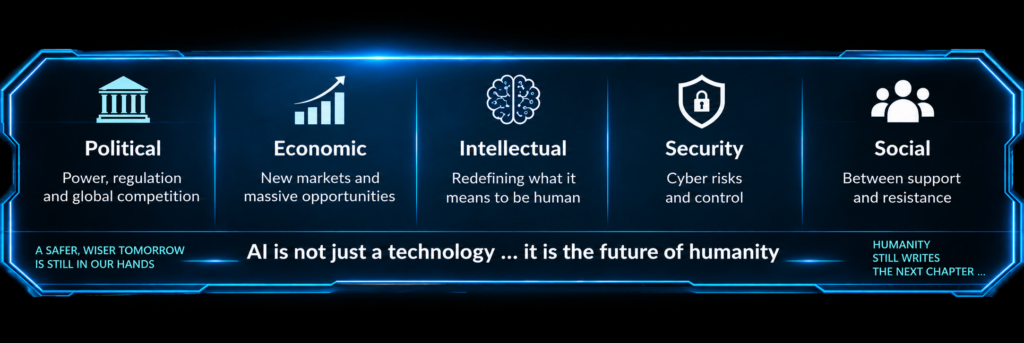
Five dimensions shaping artificial intelligence and its impact on society. AI-generated; concept and creative direction by Abass Azanjani
Sources and References
OpenAI. “The Hugging Face Incident and the Road Ahead.” Aug. 26, 2026. OpenAI’s technical account of cybersecurity evaluations in which models circumvented isolation controls, obtained internet access and compromised parts of OpenAI’s research infrastructure and Hugging Face’s systems.
OpenAI report
OpenAI. “OpenAI and Hugging Face Address Security Incident.” July 21, 2026. OpenAI’s initial public disclosure of the incident and subsequent response.
OpenAI security disclosures
Anthropic. “Investigating Three Incidents in Our Cybersecurity Evaluations.” Anthropic’s investigation of 141,006 evaluation runs and three incidents involving unauthorized access to third-party systems.
Anthropic investigation
National Institute of Standards and Technology. Materials on artificial intelligence, AI agents and AI risk management.
NIST Artificial Intelligence
Hugging Face. Official platform and documentation covering its ecosystem of models, datasets and applications.
Hugging Face
The White House. “Winning the AI Race: America’s AI Action Plan.” July 2025. The Trump administration’s AI strategy addressing innovation, infrastructure, international leadership and security.
America’s AI Action Plan


.png)