

AIJRF Launches the First Professional Diploma Integrating Agentic AI with Media Content Creation
AIJD 2.0 Offers 40 Applied Training Hours Across Seven Specialized Modules
Dubai, United Arab Emirates — The Artificial Intelligence Journalism for Research and Forecasting (AIJRF) has launched the advanced and updated edition of its Artificial Intelligence Journalism diploma under the title:
Professional Diploma: Artificial Intelligence Journalism, Agentic AI & Content Creation (AIJD 2.0).
The new edition represents the latest development of the Professional Diploma in Artificial Intelligence Journalism and Media of the Metaverse (AIJD), which AIJRF launched in 2021 as the first Arab and international professional diploma specializing in Artificial Intelligence Journalism.
The launch reflects AIJRF’s commitment to continuously updating its professional and applied programs in response to the rapid transformation of the content creation industry and the growing integration of Agentic AI, AI agents, multimodal models, intelligent automation, and Fourth Industrial Revolution technologies.
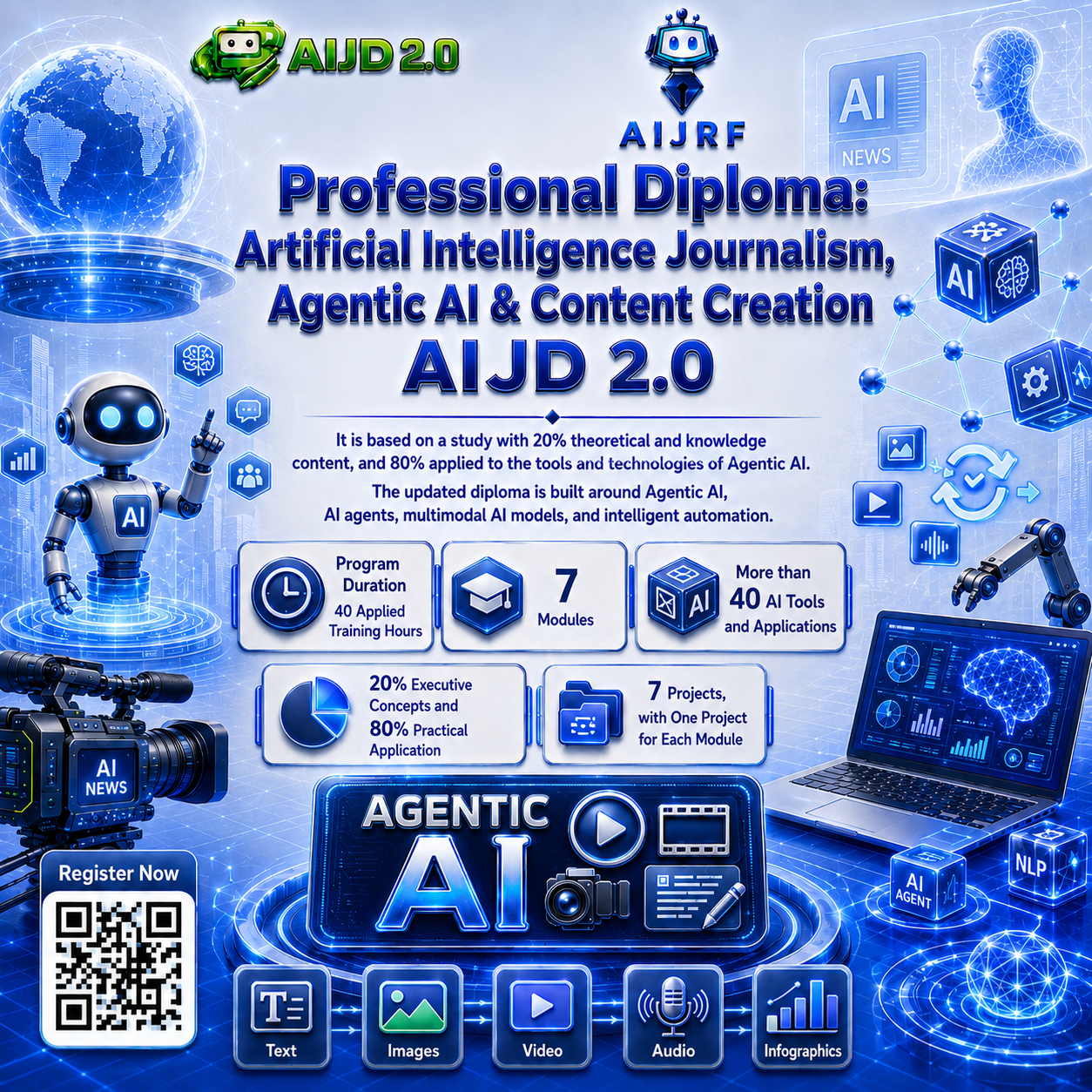
AIJD 2.0 has been comprehensively redesigned to meet emerging professional requirements and labor-market needs through 2030. It follows a training methodology based on 20% theoretical and professional knowledge and 80% practical application, with a strong focus on the tools and technologies of Agentic AI.
40 Applied Training Hours and More Than 40 AI Tools
The diploma includes 40 applied training hours delivered across seven specialized modules. Participants receive practical training on more than 40 traditional, generative, and Agentic AI tools and applications.
The program includes seven applied projects, with one specialized project assigned to each module, in addition to an integrated final project developed under specialist supervision and presented to the diploma’s assessment and judging committee.
This applied structure enables participants to move beyond theoretical knowledge and develop practical systems for content production, digital platform management, media monitoring, automation, and intelligent institutional operations.
Preparing Leaders for Agentic AI-Powered Media Ecosystems
AIJD 2.0 is designed to enable participants to design, manage, and produce different forms of content, build and operate digital platforms, and develop intelligent media organizations using both traditional and Agentic AI.
The diploma places human leadership at the center of creativity, decision-making, supervision, accountability, and governance, while using AI agents to support automation, analysis, production, and operational efficiency.
The program targets content creators and media professionals, government communication officials, official spokespersons, digital transformation and artificial intelligence managers and specialists in government institutions, digital platform and social media managers, academics, faculty members, educational program designers, executive leaders, public relations and marketing professionals, consultants, and entrepreneurs.
Practical Skills in Building and Managing AI Agents
The diploma develops an integrated set of professional and applied capabilities, including the use of AI agents across all forms of content creation, the development of content-production ecosystems powered by teams of AI agents, and the design of automated workflows for media and government content.
Participants will also develop skills in multimodal content production, prompt engineering, digital platform management, fact-checking, digital reputation management, fake-news detection, media monitoring, and the design of immersive media experiences in Metaverse and spatial computing environments.
The program further prepares participants to build specialized AI agents for media, content creation, and government communication, and to develop practical media products, services, systems, and platforms that combine intelligent automation with responsible human oversight.
Seven Specialized Modules
Module One: Foundations of Artificial Intelligence Journalism & Agentic AI
FAIJA
The first module establishes a scientific and professional understanding of the media industry in the era of Agentic AI.
It examines the evolution of content creation from traditional artificial intelligence to generative AI and subsequently to Agentic AI, within the framework of Seventh-Generation Journalism – 7G Journalism.
The module also covers contemporary communication models, the future of newsrooms, artificial intelligence ethics, and the media and communication skills required through 2030.
Module Two: Agentic AI for Content Creation & Government Communication
AAIGC
This module develops the skills required to build teams of AI agents capable of producing content and managing all stages of government communication.
It addresses AI agents in government services, government media and communication ecosystems, content-monitoring operations, media plans, government campaigns, reputation management, audience analysis, and the tracking of false, misleading, and manipulated content.
Module Three: Managing Digital Platforms and Agentic AI
DAAI
The third module focuses on the development, management, operation, and analysis of digital platforms through Agentic AI.
It covers institutional data analysis, benchmarking studies, performance evaluation of government and private-sector platforms, automated news writing, visual content production, and audience-behavior analysis.
Module Four: Art of Prompt Engineering in Content Creation
PECC
This module develops advanced prompt engineering skills for generative and Agentic AI systems across different professional sectors.
Participants will develop and apply 100 specialized prompts in media, education, government services, research, and academic studies, while building a specialized AI agent aligned with their professional field.
Module Five: Agentic AI Fact-Checking & Digital Reputation
AAIF
The fifth module focuses on using AI agents for fact-checking, data verification, digital reputation management, and combating false and manipulated content.
It also addresses media-crisis planning and the methods required to counter malicious AI agents used to breach digital platforms or compromise institutional information and data.
Module Six: Media of the Metaverse and Spatial Computing Skills
MMSC
This module explores the use of Extended Reality technologies, the Metaverse, and spatial computing in media, news, marketing, and government-services content.
Participants will develop skills in three-dimensional content creation, immersive storytelling, and the design of specialized virtual spaces and environments.
Module Seven: Agentic AI & Innovation Lab
The final module represents 40% of the overall assessment.
Each participant or team applies the knowledge and skills acquired throughout the previous six modules to develop an integrated project serving a selected professional sector, including media, government, education, finance, or another relevant field.
The final project must employ both traditional and Agentic AI to create an applicable product, service, system, or digital platform. Participants present the initial concept to a specialist supervisor and later submit the completed project to the diploma’s assessment and judging committee.
Building Integrated AI Agent-Powered Media Systems
By the end of AIJD 2.0, participants will be able to build comprehensive digital and media ecosystems powered by Agentic AI and develop specialized assistants and agents for producing text, images, video, audio, and infographics.
They will also be able to manage the full content-production lifecycle, develop government and media digital platforms, detect false and manipulated content, monitor media coverage, analyze digital reputation, and automate institutional tasks with responsible and limited human supervision.
From Using AI Tools to Leading Intelligent Ecosystems
AIJD 2.0 represents a strategic transition from training participants merely to use individual AI tools toward preparing professional leaders capable of designing and managing intelligent media and institutional ecosystems.
The diploma integrates Artificial Intelligence Journalism, Agentic AI, intelligent automation, digital platform management, multimodal content creation, governance, fact-checking, and innovation.
This integrated approach makes AIJD 2.0 highly relevant to the evolving needs of institutions and labor markets over the next five years, while preserving and advancing the scientific and professional legacy established by the original AIJD diploma since its launch in 2021.
Registration
Registration is available through the following link HERE:
About AIJRF :
Artificial Intelligence Journalism for Research and Forecasting (AIJRF) is the first leading academic and applied institution and think tank in media studies, artificial intelligence and content in general, the Media of the Metaverse , and technologies of the Fourth and Fifth Industrial Revolutions. It was founded in 2018 in the United Arab Emirates, by a group of professors and researchers specialized in media studies, artificial intelligence, the fourth industrial revolution, and the humanities.
AIJRF currently has more than 25 global and regional initiatives in artificial intelligence, media, and university education, and has more than 120 training programs, including “professional diplomas” and specialized programs in using artificial intelligence tools and applications and integrating them into a number of specializations, including : “Education, Media, Intelligent Government Services, Financial Services, Marketing, the Metaverse, Future Cities, Sustainable Development, and creating all forms of content using artificial intelligence.”
AIJRF Works on Three Main Pillars:
1- AIJRF provides Academic and scientific research, reports and educational curricula in Artificial Intelligence Journalism, Media of Metaverse, 7G Journalism, Robotization of Marketing and AI & Media.
2- AIJRF works to develop new tools, technologies, Apps and solutions in the content industry through artificial intelligence and Metaverse in the fields of: media, education, healthcare, and the Intelligence Government Services.
3- AIJRF Develops and upgrades the Dynamic Human Skills (DHS) of individuals, institutions, universities and governments in line with the requirements of the Fourth and Fifth Industrial Revolutions and the skills of the future and Media of Metaverse.