

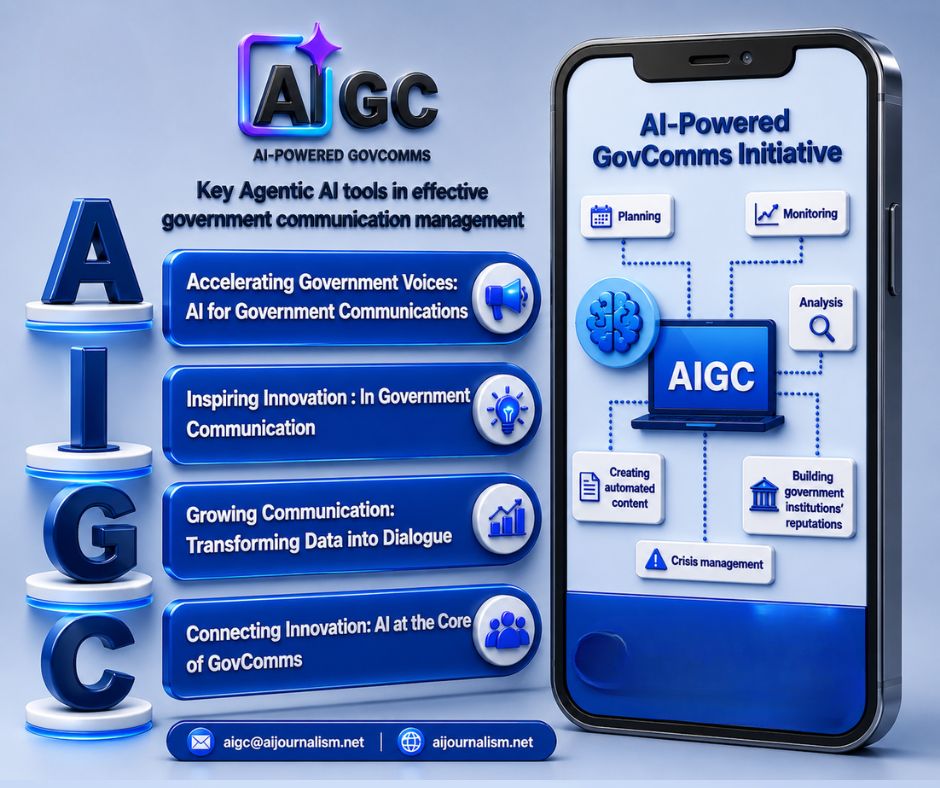
The Artificial Intelligence Journalism for Research and Forecasting (AIJRF), a scientific and applied foundation specialising in artificial intelligence and technologies associated with the Fourth and Fifth Industrial Revolutions, has launched the first phase of the AI-Powered Government Communications Initiative (AIGC).
The initiative brings together 100 government communication officials, directors and specialists from 19 Arab countries.
AIGC is part of AIJRF’s efforts to support digital transformation across Arab government institutions and equip government communication leaders and professionals to use artificial intelligence, Agentic AI and advanced technologies to develop communication operations and improve decision-making.
Dr Mohamed Abdulzaher, the CEO of AIJRF, said the initiative aims to train and qualify 3,000 government communication officials and directors over the next three years, through 2028.
It also seeks to reach more than 1,000 Arab government institutions and public entities through their government communication, corporate communication and digital media departments.
Speaking at the opening of the initiative’s first training programme, Abdulzaher said:
“Through this initiative, we are working to strengthen the integration and use of Agentic AI tools across all stages of government communication and improve access to target audiences.”
“We also seek to create a sustainable institutional impact within Arab government communication departments by combining applied training with the development of professional guides and models, specialised databases and an Arab network for exchanging expertise and best practices in AI-powered government communication.”
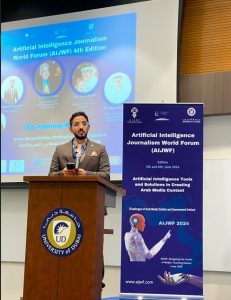
Dr. Mohamed Abdulzaher, AIJRF CEO
Agentic AI in Government Communication
Dr Ahmed Al Mansouri, a professor of media and a member of AIJRF’s academic team, said the initiative’s objectives align with the UAE government’s national direction to integrate Agentic AI into 50% of government service delivery over the next two years, as well as with broader global trends.

Dr Ahmed Al Mansouri
Al Mansouri said the role of government communication officials was changing rapidly.
Alongside traditional communication skills, professionals are increasingly required to analyse data, manage AI tools, supervise AI agents, verify outputs, assess risks and make communication decisions based on evidence and performance indicators, he said.
He added that the training programme was designed around a practical methodology that exposes participants to real-world government scenarios.
The programme helps participants convert modern tools and technologies into applicable solutions for media planning, content management, monitoring, public engagement and the management of critical situations and crises.
Building Data-Driven Government Communication Systems
The initiative seeks to improve the ability of government communication leaders and officials to use AI in their daily work.
It also aims to integrate Agentic AI into media planning, content management and decision-making, while building government communication systems based on data, analysis, prediction and automation.
The first cohort included officials and specialists from 18 Arab countries, led by the United Arab Emirates, Saudi Arabia and Egypt.
Arab Network for AI-Powered Government Communication Officials
During the launch of the first cohort of the AI-Powered Government Communications Initiative, AIJRF also announced the establishment of the first specialised Arab network dedicated to integrating AI and advanced technologies into government communication.
The new platform is called the:
Arab Network for AI-Powered Government Communication Officials (AIGC-Net)
AIGC-Net is the first specialised Arab and international professional and knowledge network of its kind to be launched and managed by AIJRF.
It aims to build an integrated professional community bringing together government communication officials and directors, official spokespersons, government media experts and specialists in artificial intelligence and advanced technologies.
The network seeks to develop government communication systems across Arab institutions by expanding the use of generative and Agentic AI, big-data analytics, intelligent automation, extended reality, metaverse technologies, monitoring systems and foresight tools.
These technologies are expected to improve government communication efficiency, accelerate response times, enhance content production and strengthen public engagement.
AIGC-Net will collect and document information about government communication departments, officials and experts across the Arab region and internationally.
It will also develop advanced professional databases to support knowledge and expertise exchange, partnership development and specialised training, consultancy and research services.
The network will provide members with a sustainable professional platform offering updated training programmes, professional and advisory services, specialised reports and studies, and opportunities for networking and cooperation.
It also plans to organise an annual international event bringing together officials, experts and professionals working in government communication, artificial intelligence and advanced technologies.
About AIJRF
The Artificial Intelligence Journalism for Research and Forecasting is the world’s first research institution specialising in media, artificial intelligence and content-creation studies.
It was founded in Dubai, United Arab Emirates, in 2018 by a group of professors and researchers specialising in media studies, artificial intelligence, the Fourth Industrial Revolution and the humanities.
AIJRF manages more than 20 international artificial intelligence initiatives, including the Artificial Intelligence Journalism World Forum, the Global Artificial Intelligence Journalism Index (GAIJI), the Arab Index for Artificial Intelligence in Universities (AIU), the AI Skills Camp for Students and the AI Skills Challenge for University Youth.
The institution offers more than 120 training programmes and professional diplomas in areas including content creation and artificial intelligence, AI technologies and smart government services, AI and media production, metaverse media, and artificial intelligence and education skills.
These include more than 20 programmes focused on integrating AI tools and solutions into professional and institutional practices.
In 2021, AIJRF issued the first edition of what it described as the world’s first professional and ethical guide for AI-powered content creation, titled the Ethical Guide for Artificial Intelligence Journalism.
A second edition was released in 2024 under the title Professional and Ethical Guidelines for the Use of Artificial Intelligence Technologies in Content Creation (AIJEC).
AIJRF’s work is focused on three main areas.
First, it produces academic and scientific research, reports and educational curricula covering content creation, artificial intelligence and media.
Second, it develops new AI tools, technologies, applications and solutions for content creation in media, education, healthcare and smarter government services.
Third, it works to develop and update the Dynamic Human Skills (DHS) of individuals, institutions, universities and governments in line with the requirements of the Fourth and Fifth Industrial Revolutions and the skills of the future.
Editorial note: The original Arabic text states that participants came from 19 Arab countries in the headline and opening paragraph, but later refers to 18 Arab countries. This numerical difference has been retained to preserve the original meaning.


.png)